Customer Care: 866.625.8532 Sales Inquiries: 503.419.3544


CarePayment Named #1 Patient Financing Solution in 2025 Black Book Research Rankings - Read Press Release
Blog | November 4, 2026
3 Eligibility Requirements that are Undermining Your Patient Financing Program

Eligibility vs. Accessibility: When Requirements Become Barriers
Eligibility requirements shape both the reach and the financial impact of a patient financing program. When patients who need support cannot qualify, their affordability challenges remain unresolved, and providers have fewer opportunities to recover payment.
CarePayment analyzed enrollment patterns across traditional non-recourse financing models and found that only about 10% of placed accounts ultimately enroll in a payment plan. The remaining 90% are filtered out before patients ever have the opportunity to participate.
Those losses are driven by three common enrollment requirements: identity verification (CIP), digital only enrollment, and mandatory AutoPay. Each requirement serves a business purpose. Together, they dramatically limit the number of patients who can access financing.
Here’s where patients are being lost.
The enrollment gates most providers never see
When a patient account enters a non-recourse financing program, it does not simply become available to the patient, it moves through a series of eligibility gates. Pass all of them, and the patient gains access to a payment plan. Fail any one of them, and the account is effectively unreachable.
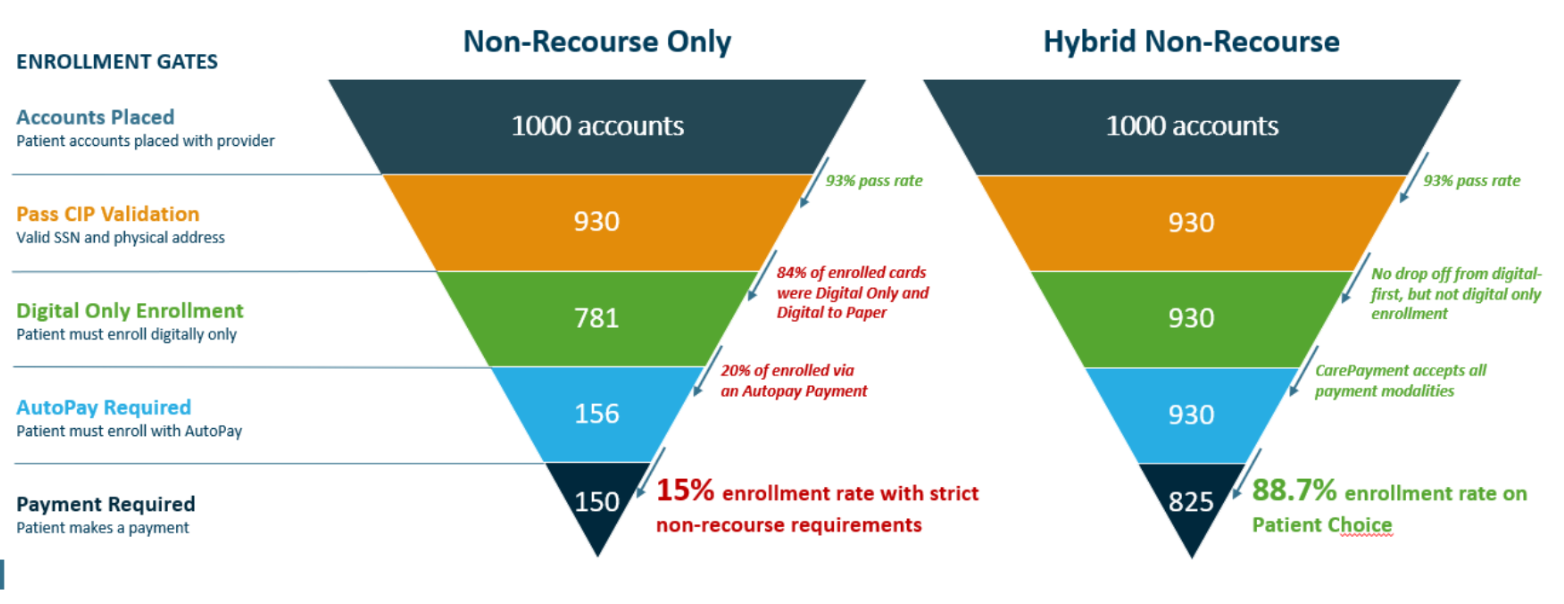
In a typical non-recourse model, CarePayment found that only 10% of the placed accounts end in enrollment. In a well-constructed hybrid model, that number is almost 90%, from the same patient population. These requirements eliminate 90% of patients before they even get offered patient plans.
Here is what is happening at each stage of requirements.
Gate 1: CIP validation
Every financing program requires some form of identity verification. In most non-recourse models, that means a valid Social Security Number and a confirmed physical address, cross-referenced against credit bureau data.
For most patients, this is a manageable step. For a significant subset, of whom are often those who need financial assistance the most, it is an insurmountable one.
Patients experiencing homelessness, patients with incomplete intake records, and patients from underserved communities frequently cannot satisfy CIP requirements. According to the CDC, approximately 40% of people experiencing homelessness are unsheltered entirely, with no stable address to validate against. Medicaid and uninsured patients often have gaps in their demographic data that flag as verification failures even when the patient is fully capable of making payments.
Strict identity verification protects the financing provider, but it also disproportionately excludes the patients the program was designed to serve. The patients with the greatest need for financial flexibility are often the ones with the least ability to clear a rigid identity check. CarePayment found that 7% of patients will become ineligible when CIP validation is required.
Seven percent may appear negligible in isolation, but across an entire patient population, applied to every account a health system, it represents a substantial and recurring loss of patients who had no opportunity to enroll, and no alternative path offered to them. The patients filtered out at this stage are also disproportionately the ones with the most urgent need for financial help, meaning the gap between who the program was designed to serve and who it reaches begins at the very first gate.
Gate 2: Digital-only enrollment
Many non-recourse financing models assume that patients can and will self-serve through a smartphone, a patient portal, or some other digital workflow. That assumption does not hold for the full patient population.
Pew Research found that 7% of Americans do not use the internet at all. At a large health system, that figure represents a meaningful and addressable population. Beyond access, digital literacy is another separate barrier. Even when technology is accessible, low digital literacy can preclude some patients from being able to access the internet for financing purposes.
Research published in PMC found that the majority of participants with low health literacy had access to technological devices and had used the internet previously, but they were unable to perform online tasks without assistance.
From our 21+ years of serving patients and providers with patient financing, we’ve found that 16% of the patient population drops at this gate. Elderly patients, non-English speakers, and patients overwhelmed in the immediate aftermath of a care episode can face similar digital friction. A digital-only enrollment pathway excludes each of these groups by design.
Gate 3: AutoPay requirement
The steepest drop out in a non-recourse-only model occurs at the AutoPay gate, where 87% of the patients who cleared CIP validation and digital enrollment fall out entirely.
A patient enrolled in Autopay offers predictable repayment, which reduces administrative overhead for the financing provider and guarantees that income month after month. The requirement, though, is structured around the provider’s operational preferences rather than the patient’s financial reality. CarePayment found that less than 13% of patients enroll in AutoPay.
Nearly a quarter of all households live paycheck to paycheck. For a patient whose income is irregular or whose monthly expenses are unpredictable, authorizing a recurring automatic deduction carries genuine risk of overdraft. Opting out of AutoPay is frequently a sound financial decision, not a signal of unwillingness to pay.
What providers are missing
When financing adoption is low, organizations often conclude that patients are uninterested or that the program needs better promotion. In many cases, patients are being screened out before they have the chance to make a decision at all. Low utilization does not necessarily mean patients don’t want to or can’t pay, it often means the program eligibility requirements need to be restructured.
The financial implications are clear. Fewer enrollments mean fewer balances converting, limited repayment improvement, and weaker operational lift relative to program costs. A financing offering that reaches only 10% of placed accounts is not fulfilling its financial case, regardless of how well it performs for the patients who do complete enrollment.
The patient experience impact is harder to capture in a spreadsheet but carries real consequences for mission-driven organizations. The dissonance comes when a hospital is offering affordability, but a patient experiences being turned away before the payment plan is even offered. That disconnect is where trust erodes, particularly for nonprofit health systems, community hospitals, and safety-net providers with a specific obligation to serve patients who have limited options elsewhere.
Building a program that reaches the patients who need it
The enrollment gap is a product of specific design choices that can easily be changed.
Programs that include non-digital enrollment paths extend access to patients who cannot self-serve through a portal. Removing mandatory AutoPay requirements opens participation to income-variable and underbanked patients. Reducing CIP validation requirements allows patients without a steady, physical address to access affordable care. Addressing all three gates produces substantially higher enrollment rates across the same patient population.
The patients hospitals are working to support, including lower-income, transient, and digitally-underserved individuals, are the same patients being filtered out at the highest rates by traditional non-recourse structures. These are the patients hospitals MOST want to help. Eligibility and accessibility must be aligned in a more effective way.
CarePayment’s Hybrid model is built around removing each of the gates that filter patients out before enrollment begins. By addressing each gap with flexibility, this model achieves an 88.7% enrollment rate on the same patient population where a non-recourse-only model reaches 10%. That gap represents hundreds of patients per health system, per year, who gain a viable path to resolving their balance rather than leaving it unaddressed.



CarePayment Integrated Engagement Platform
Comprehensive Patient Financing
Beacon Health Provider Story
Client Testimonial: The Right Partner
